Sunday, 06 April 2008 08:39am
©New Sunday Times (Used by permission)by Roger Tan in a multi-religious country like ours, religion is one issue which always invokes and provokes strong passions and reactions if not handled carefully.
In the last general election, many non-Muslims turned away from Barisan Nasional and voted for the opposition.
In some cases, church leaders even openly encouraged their Christian congregations to vote for Pas - something hitherto unthinkable, especially when Pas has always been advocating the establishment of an Islamic state.But why had non-Muslims voted for the opposition so resoundingly this time?The reason is obvious. The non-Muslims' gravamens are essentially these:
• the authorities were trigger-happy in demolishing illegal places of worship.
• the government's inaction, especially by the non-Muslim component parties in BN, in resolving the conflicts of civil law and syariah arising out of Article 121(1A) of the Federal Constitution. The problem is compounded when non-Muslims could more or less predict the outcome of the decisions of civil courts whenever a remedy was sought there.
• religious polarisation caused by the rivalry between Umno and Pas, each wanting to outdo the other in being more Islamic.
• non-Muslims find it increasingly difficult to build their places of worship.
Of these, I would only like to deal with the last grievance.
Article 3 of the Federal Constitution declares that non-Muslims are entitled to practise their religions in peace and harmony while Islam is the religion of the federation.
This is reinforced by Article 11(1) which provides that every non-Muslim has the right to profess and practise his religion. Article 11(3) also states that every religious group has the right, inter alia, to establish and maintain institutions for religious purposes and to acquire and own property and hold and administer it in accordance with law.
Sadly, in practice, this is not the case. The time taken to obtain approvals to build non-Muslim places of worship is incredibly long. In almost every case, it takes years.
The application and approval process is most cumbersome. For a start, it is almost unheard of that state governments would alienate lands for erection of non-Muslim places of worship. Hence, the lands involved are usually private lands and so before it could be used for religious purposes, the land has to be first converted for religious use. So an application will have to be made to the state authority (which is the state executive council), and it will be processed by the land office.
However, because it involves the erection of non-Muslim places of worship, most states require the matter to be first referred to a district security committee. At the district security committee level, the district office will have to obtain comments from various government departments, including the police.
The least palatable aspect of it all is that views from the Religious Affairs Department will also be sought.
Even if the district security committee approves it, the matter would still have to be referred to the state security committee, which is chaired by either the chief minister or state secretary.
In most cases, the process of obtaining comments from the various government departments is repeated.
If the state security committee okays it, it does not mean the application has been approved. It then goes to another committee chaired by the state executive councillor in charge of land matters, a position usually held by the chief minister.If the committee approves it, the state executive council has to give its final approval.
As the process takes such a long time, it is no surprise that along the way, the file is either misplaced or goes missing. In addition, sometimes there is a delay in submitting the papers for deliberation by some over-zealous junior government officers, who are mono-religious and feel that it is against their religion to support it.
The story does not end there even when the land has been converted for religious use. The next thing is to put up the building.To do that, an application will now have to be submitted to the local authority for approval of the building plans.But because it involves a non-Muslim place of worship, the process of going through the district and state security committees has to be repeated.
Even if the final approval is obtained, it still takes a few years for the building to come up. The reason being the costs of financing the construction and completion of these places of worship have to be privately raised and borne. All in all, it is not uncommon for at least 10 years to pass by the time a project comes to fruition.It follows that because the approval process is so difficult, it is no wonder illegal places of worship mushroom here and there.What is most insulting to them is the erection of their places of worship is viewed as a security threat.
Often, it has to be referred to a security committee whose composition includes representatives from the Religious Affairs Department.On the other hand, the erection of mosques is efficiently co-ordinated by one body - the state Muslim Council (Majlis Agama Islam).Land is easily made available and whenever a new housing development is completed, a place will be reserved for the construction of either a mosque or surau. Financing its construction is not a problem either.
Some two years ago, I suggested in this column ("Religious freedom the keystone" - NST, Jan 8, 2006) that each state government should set up a non-Muslim religious department to look into the religious issues affecting non-Muslims and to co-ordinate applications and funding for non-Muslim places of worship.I repeat this call and it is hoped that all state governments, whether under BN or Pakatan Rakyat, will consider this.
I am confident that any step taken to expedite the approval process and provide funding for non-Muslim places of worship will, in turn, expedite the healing process among these Malaysians who certainly feel aggrieved by this course of events.
By allowing them to freely and easily exercise their constitutional right to establish their religious sanctuaries will go a long way towards winning their hearts and minds.
In this respect, the Selangor government's decision to waive quit rent and assessment rates for all registered places of worship and schools in the state is laudable.
They now only need to pay a token annual fee of RM1.Likewise, the statement from the Pahang state secretary that it will now adopt a more liberal approach to matters concerning religion and places of worship is most welcome.
Similarly, the prime minister has pledged to improve the situation.But the most assuring of all came from the Sultan of Selangor, who said that although he is the head of Islam in Selangor, he will not hesitate to take action against any extremists and that it is important to ensure that religious freedom is defended by all.
It is hoped that everyone, be he a leader of BN or Pakatan, a Muslim or otherwise, will now take heed of the voice of the people expressed in the last general election.It is hoped, too, that politicians will be often reminded by what the regent of Perak Raja Dr Nazrin Shah said exactly a year ago at the Young Malaysians' Roundtable Discussion on National Unity and Development in Malaysia that Malaysia belongs to all Malaysians equally, and all have an equal right and responsibility to take ownership of their country and its future.
He added that the sine qua non of building a strong nation is when its citizens feel a sense of belonging and a common destiny and in our case, when Malaysians of all races, religions and origins are bound together in a common purpose.Therefore, history has always shown that suppression of a person's inherent right to freedom of religion is a recipe for disaster.
Consonantly, our leaders have also much to learn from the fair and just Muslim ruler in Sultan Abu Bakar, who ruled the state of Johor from 1886 to 1895.Though a Muslim, he was much loved by his non-Muslim subjects. Hailed as the Father of Modern Johor, he granted many plots of land for the erection of churches and temples throughout Johor.
The best testimony of his sense of fairness and justice is reflected in the Johor constitution promulgated during his reign, wherein it still contains an article proclaiming as follows:
"All the laws and customs of the country shall be carried out and exercised with justice and fairness by all the Courts of Justice and all Officers and Servants of the State between all the people of the country and the aliens who sojourn and reside under its protection, whether for a season or for a lengthened period, that is to say, without their entertaining in the least degree more sympathy or regard to partiality towards those who profess the religion of the country, namely the Muslim religion, or making any difference between those who are the subjects of the State and those who are not.
"Let us all Malaysians join hands as one people respecting each other's right to practise his religion in peace and harmony.Let us take pride rather than cringe with shame if this country is filled not only with mosques but also churches and temples.
If it is so, it is only because Malaysia is truly Asia.
May God bless us all.
*The writer is a member of the Malaysian Bar Council.
Monday, April 07, 2008
Saturday, April 05, 2008

Umno infested with 'crocs and sharks'
Source : Malaysiakini
Former Umno vice-president Tengku Razaleigh Hamzah did not mince his words today in his all-out attack against the party leadership in his speech at his Gua Musang division's special meeting.
Former Umno vice-president Tengku Razaleigh Hamzah did not mince his words today in his all-out attack against the party leadership in his speech at his Gua Musang division's special meeting.
- it has become a party of 'Malay fanatics' and that its leaders are corrupt
- lack of commitment in Umno to defend the dignity and sovereignty of the Malay royal institution
- Umno is seen as a party made up of ‘Malay fanatics’ who, for unknown reasons, like to brandish the keris when scolding other races
- A party which is corrupt, infested with ‘buaya darat’ (land dwelling crocodiles) and ‘yu-yu laut’ (sharks) who have no qualms about sweeping up and swallowing projects and government contracts as well as the rights of the poor of all races
- This image is hated by all races, not only the Malays
- Why (did the Indians & Chinese supported PAS)? Have they been put under a spell or Islamicised by PAS people? No. They did it because they believe that PAS, based on Islamic principles, is fairer than Umno to non-Malays
Read the full text of Tengku Razaleigh's speech here


Tuesday, April 01, 2008
Dr M: The baffling thing is why Umno leaders so afraid of this kid
Following report appeared on Malaysiakini today. Below are some excerpts , you can read the full text here.
- Umno was thrashed in the general election because of poor selection of candidates by ‘Sultan’ Abdullah Ahmad Badawi and ‘Kid’ Khairy Jamaluddin
- Umno has been turned into a “family party” where power is concentrated in the hands of Abdullah and his son-in-law.
- “Of course, everyone knows that the list of candidates is chosen and submitted to 'Sultan' Abdullah (Ahmad Badawi) by state leaders but once it reached to the party president, somebody else takes over,” he said.
- Saying that this nexus is destroying Umno, Mahathir told his audience with trademark sarcasm: “But this is just a rumour, don’t listen to my bad mouth!”
- “The baffling thing is why Umno leaders so afraid of this kid. The ministers should have no problem to tenyeh (smash) this kid, but it seems that they are too afraid and I don’t know why,” Mahathir said.
- “This leader is the country’s only prime minister to ever come from an opposition state (Penang)...,” said Mahathir.
Sunday, March 30, 2008
MIC branch dissolved, members become PAS supporters
News from The Star
TAIPING: The Kampung Jebong MIC branch in Simpang here was officially dissolved when 110 of its members quit the party to become members of "Kelab Penyokong PAS" (PAS Supporters Club).
Branch chairman M. Muninathan, accompanied by committee members, submitted their application forms to Bukit Gantang MP Roslan Shaharom at a village temple here on Saturday night.
Roslan said the welfare of the former MIC branch members and members of the Indian community would be taken care of.
"We will take care of you because any problems affecting the Indian community will also affect members of the other communities," he said.
Roslan said he was indebted to the Indian community here as more than 95% of Indian voters within the Bukit Gantang parliamentary constituency had voted for him in the recently-concluded general election.
He said members of the community had every reason to rejoice as two of the three state seats in the constituency had been won by Barisan Rakyat, and the victors -- Mohd Osman Mohd Jailu (Changkat Jering) and Tai Sing Ng (Kuala Sepetang) -- had been appointed exco members of the new Perak state government.
TAIPING: The Kampung Jebong MIC branch in Simpang here was officially dissolved when 110 of its members quit the party to become members of "Kelab Penyokong PAS" (PAS Supporters Club).
Branch chairman M. Muninathan, accompanied by committee members, submitted their application forms to Bukit Gantang MP Roslan Shaharom at a village temple here on Saturday night.
Roslan said the welfare of the former MIC branch members and members of the Indian community would be taken care of.
"We will take care of you because any problems affecting the Indian community will also affect members of the other communities," he said.
Roslan said he was indebted to the Indian community here as more than 95% of Indian voters within the Bukit Gantang parliamentary constituency had voted for him in the recently-concluded general election.
He said members of the community had every reason to rejoice as two of the three state seats in the constituency had been won by Barisan Rakyat, and the victors -- Mohd Osman Mohd Jailu (Changkat Jering) and Tai Sing Ng (Kuala Sepetang) -- had been appointed exco members of the new Perak state government.
Wednesday, March 26, 2008
Another coalition of NGOs?
A group of some 20 Perak Malay non-governmental organisations (NGOs) has voiced its concern over the fate of Malays under the new DAP-PKR-PAS government in the state, as reported by the star here.
A fellow blogger reveals they might not be real NGOs after all. Link here.
A fellow blogger reveals they might not be real NGOs after all. Link here.
Sunday, March 23, 2008


Friday, March 21, 2008
Monday, March 17, 2008


Saturday, March 15, 2008

Wednesday, March 12, 2008

Sunday, March 09, 2008
Rakyat Telah Bersuara!

Reactions to the political tsunami that struck most parts of Malaysia yesterday.
= = = = = =
Dr.M : "My view is he (Badawi) has destroyed Umno, destroyed the BN and he has been responsible for this."
= = = = = =
Anwar Ibrahim : "The people have voted decisively for a new era where the government must be truly inclusive and recognise that all Malaysians, regardless of race, culture or religion are a nation of one,"
= = = = = =
Koh Tsu Koon : “I will meet with the party leaders to convey my decision. As a captain of the ship, I take full responsibility of what has happened,”
= = = = = =
NST : "BN ROCKED"
= = = = = =
The Star : "Political Tsunami"
Friday, March 07, 2008
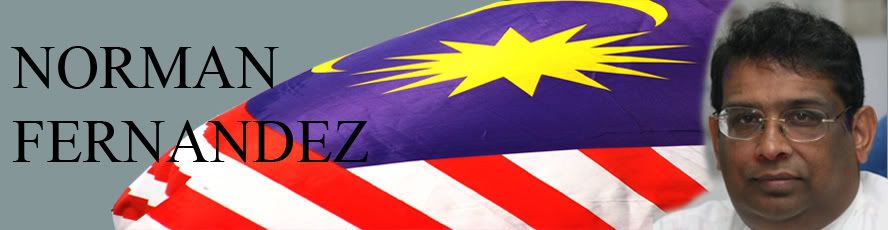
N.45 STULANG NORMAN FERNANDEZ.

My name is Norman Fernandez. I am the candidate for DAP. In 2004 I was the candidate for Stulang N.45. Although I did not succeed, I have continued to serve the people of Stulang. I am once again contesting in Stulang. The truth, is that I am the underdog in Stulang and I am taking the might of BN-MCA. Add to that is another candidate from PRM who has dropped by into Stulang to contest election.
I urge you the voters of Stulang to vote for DAP, a party which has for 40 years fought to ensure your culture, language, education, religion and your constitutional rights are not eroded. For more than 40 years DAP has committed to the service and struggle for Malaysians. It is for this reason DAP continue to have the trust of the people.
I urge you the voters of Stulang to vote for DAP, a party which has for 40 years fought to ensure your culture, language, education, religion and your constitutional rights are not eroded. For more than 40 years DAP has committed to the service and struggle for Malaysians. It is for this reason DAP continue to have the trust of the people.
You too can trust me when I say to you the voters of Stulang N.45 that :-
(i) I promise to use all my ability and resources to serve the people of Stulang.
(ii) I promise to voice out without fear the problems and concerns of the people of Stulang.
(iii) I promise to ensure that the all relevant authorities including the state government:-
(i) I promise to use all my ability and resources to serve the people of Stulang.
(ii) I promise to voice out without fear the problems and concerns of the people of Stulang.
(iii) I promise to ensure that the all relevant authorities including the state government:-
(a) make Stulang crime free and safe for the people.
(b) that the local authorities (MBJB) provide quality service and good infrastructure
and amenities for the people of Stulang.
My motto “Dedikasi, Amanah and Prihatin”. That is what I promise you the voters of Stulang. I am committed to serve and ready to serve. Your vote and each and every vote will be an encouragement for me to serve you even better. Please vote Norman Fernandez. Please vote DAP.
My motto “Dedikasi, Amanah and Prihatin”. That is what I promise you the voters of Stulang. I am committed to serve and ready to serve. Your vote and each and every vote will be an encouragement for me to serve you even better. Please vote Norman Fernandez. Please vote DAP.
Thursday, March 06, 2008
Tuesday, March 04, 2008
EC's Incredible Indelible-Ink Flip Flop
EC: Indelible ink will not be used
Tuesday, 04 March 2008
The Election Commission has cancelled the use of indelible ink for this general election, citing public order and security issues.
The stunning announcement was made at a press conference in Putrajaya this afternoon - four days before polling. The announcement was made by EC chairperson Abdul Rashid Abdul Rahman. Also present at the press conference were Attorney General Abdul Gani Patail dan Inspector General of Police Musa Hassan.
The indelible ink was to be introduced for the first time in Malaysia as part of efforts to enhance transparency.
In line with this, along with the introduction of the ink, the EC had also allowed for the casting of postal ballots to be observed by polling agents and the use of transparent ballot boxes.
The EC believed that the changes would quell some of the allegations that Malaysian elections are not free and fair.
In preparation for the use of the indelible ink, the EC had previously said that it would buy approximately 48,000 bottles of indelible ink worth RM2.4mil from India.
Women voters were also repeatedly reminded to remove their nail polish before going to the polls on March 8, as it would be difficult to apply the ink otherwise.
However even prior to today’s shocking EC back track, questions were being asked as to how the EC can compel voters to apply the ink as elections laws have not been amended to include the provision for the use of the indelible ink.
The EC overcame this burden by stating that voters who were against the use of indelible ink would have to fill out a form seeking to be excused before the cast their vote.
The opposition has two days ago ticked off the EC for appearing to have second thoughts on the introduction of the indelible ink.
R Sivarasa, the candidate for Selangor's Subang, said that the ink would stop possible incidences of multiple voting.
"They misled all Malaysians, not only yourselves, the voters of Malaysia and us, that they would implement the (use of) indelible ink - they also issued numerous statements about how much indelible ink would cost and they said they would buy it." - M'kini
Tuesday, 04 March 2008
The Election Commission has cancelled the use of indelible ink for this general election, citing public order and security issues.
The stunning announcement was made at a press conference in Putrajaya this afternoon - four days before polling. The announcement was made by EC chairperson Abdul Rashid Abdul Rahman. Also present at the press conference were Attorney General Abdul Gani Patail dan Inspector General of Police Musa Hassan.
The indelible ink was to be introduced for the first time in Malaysia as part of efforts to enhance transparency.
In line with this, along with the introduction of the ink, the EC had also allowed for the casting of postal ballots to be observed by polling agents and the use of transparent ballot boxes.
The EC believed that the changes would quell some of the allegations that Malaysian elections are not free and fair.
In preparation for the use of the indelible ink, the EC had previously said that it would buy approximately 48,000 bottles of indelible ink worth RM2.4mil from India.
Women voters were also repeatedly reminded to remove their nail polish before going to the polls on March 8, as it would be difficult to apply the ink otherwise.
However even prior to today’s shocking EC back track, questions were being asked as to how the EC can compel voters to apply the ink as elections laws have not been amended to include the provision for the use of the indelible ink.
The EC overcame this burden by stating that voters who were against the use of indelible ink would have to fill out a form seeking to be excused before the cast their vote.
The opposition has two days ago ticked off the EC for appearing to have second thoughts on the introduction of the indelible ink.
R Sivarasa, the candidate for Selangor's Subang, said that the ink would stop possible incidences of multiple voting.
"They misled all Malaysians, not only yourselves, the voters of Malaysia and us, that they would implement the (use of) indelible ink - they also issued numerous statements about how much indelible ink would cost and they said they would buy it." - M'kini
Monday, March 03, 2008
LIM KIT SIANG – Vote DAP in Stulang
Skudai, March 3, 08. Lim Kit Siang today during the “meet the Johor DAP candidates sessions” urged voters of STULANG to vote for DAP. DAP is fielding Norman Fernandez a 44 year old lawyer in Stulang state seat.
Norman Fernandez is engaged in a three corner fight with Barisan Nasional MCA Mok Chek Hou and the third candidate S.K Song.
According to Lim, in truth the contest in Stulang is between Barisan Nasional MCA and DAP. That should be the choice. To vote the third candidate would only mean to split the votes and give Barisan Nasional a victory by default.
- WARTA STULANG -
Norman Fernandez is engaged in a three corner fight with Barisan Nasional MCA Mok Chek Hou and the third candidate S.K Song.
According to Lim, in truth the contest in Stulang is between Barisan Nasional MCA and DAP. That should be the choice. To vote the third candidate would only mean to split the votes and give Barisan Nasional a victory by default.
- WARTA STULANG -
Friday, February 29, 2008
Wednesday, February 27, 2008
THE POWER OF TRUTH OF M.I.C VS THE REAL TRUTH OF REALITY

Newspapers today published M.I.C’s report card titled “The Power of Truth”, proudly claiming all the things it has done for the Indian community. Instead of telling us the actual truth and giving the true figures, M.I.C instead asks the voters questions.
M.I.C questions the community :-
WHO SAYS MIC HAS NOT DONE ENOUGH?
When has enough ever been enough, all requests for assistance have been entertained (be it for RM100 or RM10,000-00 or more).
· Do you know how many medical bills have been settled by MIC?
· Do you know how many underprivileged Indians today own houses, thanks to MIC?
· Do you know how many lawyers and doctors have been created by MIC or as a result of
MIC’s contribution?
· Do you know how much educational aids MIC has given to-date?
MIC claims that it had supposedly :-
MIC HAS NEVER SAID NO !
· We have never said NO to your problems.
· We have never said NO to your children’s education.
· We have never said NO to your financial difficulties.
· We have never said NO to your medical bills.
· We have never said NO when you want provisions for your family.
. We have never said NO when you need money to conduct a decent death rite(s) for your
loved one.
· We have never said NO to you approaching us at any time. That’s the plain truth.
Now here is the REAL TRUTH which M.I.C did not tell.


Tuesday, February 26, 2008
Deny them a two-thirds' majority
BY P RAMAKRISHNAN, Aliran president.
As polling day draws closer, we are reminded that the only way to stop politicians from manipulating issues of race and religion is to deny the ruling coalition a two-thirds’ majority. After hearing the moving personal tragedies of some unfortunate Malaysians, it would appear that we are heading for turbulent times.
It is rather sad that religion that is responsible for our inner spirituality and our common humanity should be the centre of the storm. We really cannot fault religion for this. It won’t be fair. After all, doesn’t religion instil and inspire in all of us the good values of living a decent life that reflects our compassion for one another, our love for justice, our craving for human dignity, our search for peace and harmony, our desire to fight corruption, our longing to be treated without discrimination?
This is very much so if we reflect on our past and recall our own experiences. I come from a tiny town in a rural setting. We, the people, got on very well. My classmates – Chinese, Indians and Malays – had no qualms in visiting me and sharing our food and spending the night under our roof. Religion never got in our way. It did not form a barrier and did not keep us apart. We used to call one another in jest, "Dei Hindu, Hoi Cina, Hei Melayu" and nobody got offended.
In that tiny town lived a Malay boy. I’m sure he also remembers the peace of the place and the uncomplicated life that bound the people of the town as a community.
I still recall those wonderful days with a tinge of sadness and fondly remember the easy mingling of the races and the friendly faces of people. Race never had any consideration and friends were just people.
Those were the days when you could eat in front of a fasting Malay friend who did not mind it at all. PE lessons were not suspended. Fasting Malay friends then seemed to have boundless energy and we used to play football immediately after school in the hot sun. They were none the worse for it. It would appear that my Malay friends then were made of sterner stuff!
That tiny town is Kepala Batas and that Malay boy is today the Prime Minister of Malaysia.
Coming from such a background, I find it so disturbing when race is manipulated and religion is used to cause discord among us. I am not referring to any particular community because every community is guilty of this in one form or another.
What went wrong, you may ask. Well, over the years some religious zealots have become very vocal and very demanding. And when they realised that nobody dared to question them, they became bolder and their voices got shriller.
We have reached such a stage that the state now intrudes into our privacy and dictates to us on almost everything. We are told what to believe and how to pray. But isn’t religion something very personal between you and your God? Has the state any business to intrude into that area?
The state intrudes into your freedom and decides what you can see and what you cannot. It treats you as if you don’t have any common sense and can’t think for yourself.
Now – and this is difficult to believe, mind you – of all things, it says you can’t vote according to your conscience. How can you talk about morality and integrity and honesty when you are forced to fall back on herd mentality? How can you be religious and not be conscionable?
It is this turn of events that has affected the body politic of this nation. The majority of sane and sensible Malaysians not only failed to stand up and be counted but they chose to withdraw into their cocoons paving the way for these zealots to take over completely and have a field day.
Today we are reminded of that saying, "We have enough religion to make us hate, but not enough to make us love one another."
So we have this situation in certain circumstances when you are unable to bury your kith and kin according to your beliefs and rites. Where does that leave you?
It would seem that Muslim judges in civil courts find it a problem to adjudicate when Islam is involved, as was the case of someone who wanted the word "Muslim" to be changed in her MyKad. But Justice Gopal Sri Ram, who sat in the same court, had no problem in taking a legal position based on justice.
Then we have the case of Moorthy’s widow whose case did not go through the full trial for a verdict. The judges who sat on this case merely abdicated their responsibility and ruled that it was beyond their jurisdiction to try this case.
When one finds that the doors of the judiciary are shut in one’s face where does one go for justice? Can a civil court refuse to sit in judgment and deny justice to a litigant? Isn’t the court the last resort for justice? If judges cannot dispense justice, should they be sitting on the bench?
When the AG’s Chambers and the court ignore the constitutional provisions and act contrary to their constitutional oath of office, they leave us totally bewildered and frustrated.
We heard that there were rights and freedom for the citizens in the Federal Constitution. But what has happened to those rights and freedom that came with the Merdeka Constitution?
They have been whittled away by subsequent rules and regulations and subsidiary legislation. Our rights and freedom have been stolen from us.
But don’t blame the government for this. They only did what had to be done. Over the years there have been 600 amendments made to the Federal Constitution.
How did the 600 amendments come about? How is it possible for the government to dilute and make meaningless those very rights that were promised and guaranteed to us?
It’s really simple. To amend the constitution, a two-thirds majority is required. Who gave them that two-thirds majority?
The overwhelming majority support given to them has eroded our fundamental rights, thus denying us relief and justice.
They will tell you that they need a two-thirds majority to govern effectively – mind you, not justly – but effectively.
What have they achieved that cannot be achieved by a simple majority? Do you need a two-thirds majority to wipe out corruption, to be transparent and accountable? Do you need a two-thirds majority to provide housing and health care?
Look how they have squandered our money with mega projects. Do the tallest concrete towers mean anything to any of us here? The builders of the twin towers basked in the glory of being the tallest building in the world. Only for a while though - for we no longer enjoy that prestige. But how much money has been squandered away at the expense of the needy and the deserving? Why do they need a two-thirds majority when they can’t even build a crooked bridge with a 90 percent majority?
It is this two-thirds majority that has been the curse of our democracy. It is this two-thirds majority that is threatening our civil liberties and our freedom of religion. It is this two-thirds majority that makes a mockery of Article 8(1) which reads, "All persons are equal before the law and entitled to the equal protection of the law". And friends, what we have now is rule by law, and not rule of law.
How do we win back our legitimate rights and put a stop to this erosion of our fundamental rights? The next time you cast your vote think carefully. Ask yourself if you are casting away your rights?
We should henceforth never give a two-thirds majority to any government. We should work collectively to reduce this majority and rescue our stolen rights. What we are proposing to accomplish is nothing new. It is an on-going eternal struggle. Way back on May 27, 1834 – over 170 years ago – Daniel Webster was quoted as saying, "The contest, for ages, has been to rescue Liberty from the grasp of executive power." That’s what we are going to do: Rescue Liberty.
If we want to claim our right to be "equal before the law" as promised under Article 8, if we want to safeguard the freedom of religion as guaranteed under Article 11, then we must be prepared to walk that extra mile to win those rights.
"Democracy," observed Plato, "is based upon the conviction that there are extraordinary possibilities in ordinary people." Plato was actually referring to us. We are the ordinary people with extraordinary possibilities.
If you want to be further motivated, perhaps this quotation may help: "Since the beginning of time, governments have been mainly engaged in kicking the people around. The astonishing achievements of modern times... is the idea that the citizens should do the kicking."
Friends, I fervently believe that we can do two things: Do something or do nothing. I choose to do something. If you choose to do nothing, it means that you have no grievance and no rights.
--------------------------------------------------------------------------------
P RAMAKRISHNAN is Aliran president. This article first appeared in Aliran Monthly. It was an address that was meant to be delivered at a forum on ‘The Federal Constitution: Protection for all’on May 14, 2006 in Penang. The forum was disrupted by an unruly mob.
Source : Malaysiakini.Com
Monday, February 25, 2008
TO VOTERS OF N.45 STULANG,JOHOR BAHRU

I am the DAP candidate for STULANG. Although I did not succeed in 2004 when I stood in Stulang, I have continued to serve the people of Stulang and Johor Bahru as I had promised to do.
Stulang is a highly urban constituency with many housing areas and businesses. Many of the businesses like restaurant, shopping and entertainment centres located in Taman Pelangi and Sentosa are also the focal point of foreign visitors particularly Singaporeans to Stulang.
However, the people of Stulang faces problems with:-
CRIME… INFRASTRUCTURES… DELIVERY
Crime continues to be a problem. Barisan Nasional has failed to deliver its promise of lower crime. Snatch thieves...burglary…robbery and murders still happen and too frequently. No surprise Johor Bahru is known as Jenayah Banyak People live in fear and worry. Many people of Stulang and Johor Bahru have fallen victim. Some have have lost their lives. Many victims do not even bother to report due to the inconvenience of making police reports. The high incidence of crime also gives a bad image to Stulang and Johor Bahru. Stulang and Johor Bahru businesses rely much on foreign visitors. Crime is beginning to discourage visitors and as a result business drops.
Infrastructures like roads are in poor conditions. The roads in Stulang and Johor Bahru are in deplorable condition because of poor workmanship and it is poorly maintained. Potholes and uneven roads are everywhere. No surprise Johor Bahru is known as “Jalan Buruk” There are streets with poor lighting. Drainage in may areas is poor. All this pose a danger to the public. Open and green spaces are being lost to development and becoming coming rare.
Delivery system by the local council is still bureaucratic and continues to inconvenient the public. Unnecessary time is wasted when dealing with the local council. Local councils waste public taxpayers money with shoody workmanships and on other non priority things. Local Councils also waste money on study trips abroad which are in truth nothing but holidays. Local council regulations implemented without due consideration and implemented without proper consultation inconveniences business.
It need not continue to be like this. This election you have a choice . To continue to vote for Barisan Nasional who promised to deliver so much but on being elected failed on it promise or an effective and stronger opposition who is prepared to provide an effective check and balance to the government. You the voter have a choice to stand condemned repeating the past mistakes and failures or to change and give the opposition. You have a choice. You can change. You have the choice to vote for someone who is prepared to stand up for the people... speak without fear and dedicate service to the people. I am prepared… I am ready to serve… I promise to serve. Give me a chance.
VOTE DAP. VOTE NORMAN FERNANDEZ
I, PROMISE…
I shall fight to ensure…
SAFER STREETS
• Increase in the number of policemen
• Increased, continuous and consistent police patrol to reduce crime
• More neighbourhood police stations and police beat base.
• A more effective Rukun Tetangga
• Increase Chinese and Tamil speaking police personal at every police station in order to be able
to assist people who have difficult speaking Bahasa Malaysia.
• Installation of more CCTV’s in public places
LOCAL GOVERNMENT
• Local government elections to ensure accountability and efficiency
• No wastage of public and tax payers on projects of whims and fancies
• Demand well maintained infrastructures, facilities and public roads
• Ensure playground and open green parks and field in every housing areas
• Ensure local council policies and rule changes do not inconvenient local businesses and traders
• Ensure transparency, good governance and no corruption
• Ensure a people first local government
• Ensure that green lungs are not lost to development
• Streamline bureaucracy, reduce red tape and improve effectiveness
• Transparency, fairness and corruption free
• Good clean and a green environment
• Improve public transportation system and better road planning for a congestion free roads.
• Local councils to ensure sufficient and safe parking areas
• Johor State government to consider to permit and allow Singapore MRT service into Johor
• Installation of more CCTV’s in public places
LOCAL GOVERNMENT
• Local government elections to ensure accountability and efficiency
• No wastage of public and tax payers on projects of whims and fancies
• Demand well maintained infrastructures, facilities and public roads
• Ensure playground and open green parks and field in every housing areas
• Ensure local council policies and rule changes do not inconvenient local businesses and traders
• Ensure transparency, good governance and no corruption
• Ensure a people first local government
• Ensure that green lungs are not lost to development
• Streamline bureaucracy, reduce red tape and improve effectiveness
• Transparency, fairness and corruption free
• Good clean and a green environment
• Improve public transportation system and better road planning for a congestion free roads.
• Local councils to ensure sufficient and safe parking areas
• Johor State government to consider to permit and allow Singapore MRT service into Johor
Bahru and or to start railcar service between Johor Bahru to Woodlands, Singapore to reduce
congestion and to improve environment
• The building of more NGV petrol stations
BUSINESS AND PETTY TRADERS
• Ensure clear guidelines for procedures for obtaining business and trading licences
• More opportunities and more predefined places for petty trading activities
• Non harassment on petty traders by local council
• No discrimination on award of licences and permits
• Loans for those involved in small businesses and petty trading
HOUSING AND LOW COST HOMES AND PLACES OF WORSHIP
• Ensure a squatter free Johor Bahru
• Ensure the poor is provided with affordable low cost houses
• Fair and transparent policies in the allocation of low cost houses
• Ensure that application procedures for low cost house simplified and to ensure loans be easily
• The building of more NGV petrol stations
BUSINESS AND PETTY TRADERS
• Ensure clear guidelines for procedures for obtaining business and trading licences
• More opportunities and more predefined places for petty trading activities
• Non harassment on petty traders by local council
• No discrimination on award of licences and permits
• Loans for those involved in small businesses and petty trading
HOUSING AND LOW COST HOMES AND PLACES OF WORSHIP
• Ensure a squatter free Johor Bahru
• Ensure the poor is provided with affordable low cost houses
• Fair and transparent policies in the allocation of low cost houses
• Ensure that application procedures for low cost house simplified and to ensure loans be easily
and readily available for the applicants.
• Ensure that there are fair amount of land spaces allotted for the construction of places of
• Ensure that there are fair amount of land spaces allotted for the construction of places of
worship.
GENDER EQUALITY
• Protect women’s right
• Respect and protect women’s dignity
• Ensure women are not discriminated on the ground of gender, age, marital status, race and
GENDER EQUALITY
• Protect women’s right
• Respect and protect women’s dignity
• Ensure women are not discriminated on the ground of gender, age, marital status, race and
religion
• Job opportunities, business and financial assistance for single mothers.
MALAYSIA FIRST
• Promote sense of patriotism and Malaysia First identity
• Ensure racial harmony, religious tolerance and appreciate multiculturalism
• Respect Islam as the official religion of Malaysia
• Ensure loyalty to the King and Country
• Honour and uphold the Federal Constitution
• Uphold good moral and the rule of law
JOHOR FOREVER
• Loyalty to the Sultan of Johor
• Honour and uphold the Constitution of Johor
• Ensure patriotism and pride being a citizen of Johor
FOREIGNER WORKERS IN JOHOR
• Ensure foreign workers respect and uphold the law
• Local Council and police to monitor the presence of foreign workers
• Local Council, police and RELA to conduct regular spot checks on foreigners
• Local Council, police and RELA to ensure Johor free from illegal immigrants
• Local Council to ensure that foreign workers do not engage in whatsoever business especially
• Job opportunities, business and financial assistance for single mothers.
MALAYSIA FIRST
• Promote sense of patriotism and Malaysia First identity
• Ensure racial harmony, religious tolerance and appreciate multiculturalism
• Respect Islam as the official religion of Malaysia
• Ensure loyalty to the King and Country
• Honour and uphold the Federal Constitution
• Uphold good moral and the rule of law
JOHOR FOREVER
• Loyalty to the Sultan of Johor
• Honour and uphold the Constitution of Johor
• Ensure patriotism and pride being a citizen of Johor
FOREIGNER WORKERS IN JOHOR
• Ensure foreign workers respect and uphold the law
• Local Council and police to monitor the presence of foreign workers
• Local Council, police and RELA to conduct regular spot checks on foreigners
• Local Council, police and RELA to ensure Johor free from illegal immigrants
• Local Council to ensure that foreign workers do not engage in whatsoever business especially
petty trading
• Ensure all foreign workers have legitimate and proper documentation
• Ensure foreign workers do not establish illegal housing settlements
• Local Council to ensure landlords renting premises to foreign workers to provide details to
• Ensure all foreign workers have legitimate and proper documentation
• Ensure foreign workers do not establish illegal housing settlements
• Local Council to ensure landlords renting premises to foreign workers to provide details to
Local Council


Sunday, February 24, 2008

Saturday, February 23, 2008

Friday, February 22, 2008
Our values and the coming polls
By DR M NADARAJAH
Multi-cultural Malaysia is significantly multi-religious. A multi-religious environment is within which we transact our daily lives. Various religious meanings and symbolic ecologies envelop all of us differentially.
Such ecologies produce sympathetic emotions and universal values, both of which, if nurtured with matured openness, have the potential to guide us towards a future shaped by diversity, dialogue and common destiny.
In the last six months, that future has been subtly seeking a hearing. All of us have, in some form or other and to varying extent experienced a number of socio-political convulsions. We have had an active period seeking political renewal and re-orientation of our social landscape.
In a deep sense, the rich symbolic meanings inherent in the Malaysian religious environment articulate the values that have also animated these ‘rallies for renewal’.
Consider the following religious festivals and events, covering a period of six months.
Deepavali ("light in a row of oil lamps") is a festival of lights. It symbolises and celebrates the victory of light over darkness, of good over evil. Cleansing rituals and thanksgiving mark it. Christmas is the model of accountability because it is a promise kept to spiritually save humanity. It symbolises a critical gift that human beings have received for their own redemption and reconciliation.
Awal Muharram captures the symbolism of light overcoming darkness. It relates to the Hijrah, a journey away from a situation that is marked by bad or oppressive realities. Ponggal brings people together to share and to have fun. It is to mark thanksgiving to bountiful Mother Earth and friendship to fellow beings. Thaipusam is marked by endurance and fortitude, patience and perseverance, sacrifice and suffering and unity of purpose. And finally, the Chinese New Year symbolises a strategy to deal with Nian, a man-eating beast from the mountains (or in some version, seas), through use of loud noises and the colour red. A strategy of colour, community and loud noise to chase the bad of the land seem so familiar.
Do all these not touch the imagination, hope and aspirations of the ‘rallies of renewal’ of the recent past? When we recast the symbols and meanings articulated by the various religious festivals and events on to the secular plane, can we not see some significant continuities?
The continuity of the values captured above can be seen in the movements that engaged many of us directly or indirectly and made us to think and to feel as to what is happening to us as a people and nation. Like the season for renewal in nature, the generation of the future came with their Bersih rally. Following them, came those from the margins of society, with their Hindraf rally. Then the lawyers were to have a rally for democracy and the rule of law that respects the rights of people (not in word but in spirit). A number of smaller but significant calls for gatherings and rallies continued.
Religion-based meanings that envelop all of us were the same as that which seem to have symbolically influenced the recent rallies of renewal. The rallies seem to suggest not only an exercise of our democratic rights but also a development of our religious and spiritual journey as a people, even if we do not recognise it as such. It is in these rallies that we find the projection of values that nurture and make our future democratic and sustainable all round.
As a contrast, reflect for a moment the other world and values that affect us. Like a bad omen, last year ended with a scandal and the New Year started with one, both black gifts to the history of Malaysia from the ruling front. Recall/remember the hoarding "Another Project by the Barisan Nasional Government". Are not these scandals also some of the ‘projects’? The year 2007 ended with the Lingam Tapes scandal, which has taken us deeper and deeper into the labyrinth of abuse of public office and power. And, revealed the slow destruction of institutions of democracy.
The year opened with another scandal, another tape broadcasting the private life of a public servant…a broadcast really depicting seduction and corruption of public life by and for power. This ‘project’, by a component party of the ruling front, is certainly a display of "sewage politics" rampant in Malaysia.
In a sense, for those with faith in the system, the coming elections offer two orientations or pathways to our future: an active engagement with the ‘politics of renewal’ or a passive participation in ‘sewage politics’.
The people of Malaysia have this choice before them. The choice of those parties that support the former also provides an opportunity to nurture the religious and spiritual foundations of this nation. The other choice would mean that we wait and/or spend more time possibly watching video tapes i.e. watching dramas that unfold the folly of our choice!
-------------------------------------------------------------------------------------------------
DR M NADARAJAH is a sociologist by training. He is Secretary of the Asian Communication Network (ACN), an inter-faith and inter-disciplinary social communication initiative, based in St John’s University, Bangkok. He belongs to the Asian Public Intellectuals (API) Community, a community of filmmakers, theatre people, song writers, poets, activists and academics working in Thailand, Malaysia, Indonesia, Philippines and Japan for a better Asia. His work focuses on cultural and sustainability issues.
DR M NADARAJAH is a sociologist by training. He is Secretary of the Asian Communication Network (ACN), an inter-faith and inter-disciplinary social communication initiative, based in St John’s University, Bangkok. He belongs to the Asian Public Intellectuals (API) Community, a community of filmmakers, theatre people, song writers, poets, activists and academics working in Thailand, Malaysia, Indonesia, Philippines and Japan for a better Asia. His work focuses on cultural and sustainability issues.
Original post at Malaysiakini.Com

Thursday, February 21, 2008
Just Change - DAP 2008 Election Campaign Song
Bahasa Malaysia Version
http://www.youtube.com/watch?v=rJqA_ZiR_yY
Chinese Version
http://www.youtube.com/watch?v=QuH9cvzyrb0
DAP 2008 Election Campaign Song Lyrics Just Change- DAP 2008 Election Campaign Song
Lyrics by Tony Pua
Just change for Malaysia
Just change for Malaysia
Just change we will over come
Just change we will see the sun
Together all races stand as one
Together we will never run
Together it's like never before
Together what we're fighting for
Just change for Malaysia
Just change for Malaysia
Just change we will over come
Just change we will see the sun
Corruption
We will stop the drain
Senseless crimes
We will end the pain
Inflation
We will also tame
Together
We will rise again
Just change for Malaysia
Just change for Malaysia
Just change we will over come
Just change we will see the sun
We will fight for our rights to be free
For equality
Justice we will defend, leaders
must have integrity
(Forever)
Malaysians must come first
(and never)
will we be coerced
(remember)
if we vote wisely
(together)
We will make history
(everyone of us must make that change)
Just change for Malaysia
Just change for Malaysia
Just change we will over come
Just change we will never run
Just change for Malaysia
Just change for Malaysia
Just change we will over come
Just change we will see the sun
Just change...
Monday, February 18, 2008
GE 2008 (video pt1)
Excellent video on the plight of Indian in Malaysia.
You can download the entire video onto your PC or mobile phone by right right-clicking this link and choose "Save As".
Saturday, February 16, 2008
Hindraf Rose campaign
Police fired tear gas and chemical-laced water cannons in a bid to disperse some 300 Hindu Rights Action Force (HINDRAF) supporters who gathered for a peaceful event in Jalan Raja Laut, Kuala Lumpur, early this morning.
Monday, February 11, 2008
Malaysian Income Rose by 40% over 3 years ?
Original Post by Tony Pua at
The Star reported that Malaysia's per capita income rose by 40% in 2007 compared with 2004 according the Second Finance Minister, Tan Sri Nor Mohamed Yakcop in Penang. He said that per capita income was now RM22,345 compared with RM15,819 previously.Nor Mohamed Yakcop must either be completely out of his mind, or can no longer perform simple Mathematics or worse, attempting to insult the intelligence of ordinary Malaysians.
Malaysia's Gross Domestic Product (GDP) grew by 5.0%, 5.9% and an estimated 6.0% in 2005, 2006 and 2007 respectively according to the Government's official statistics.Based on the above growth rates over the past 3 years, Malaysia's GDP grew by approximately 17.9% from 2004 to 2007.Income or GDP per capita is calculated by dividing the GDP with the total population. Therefore, it is completely inconceivable that our per capita income increased by 40% when our GDP grew by only 17.9%. Unless of course, the honourable Minister believes that our population shrunk by some 16%! To achieve 40% growth, Malaysia must be growing in excess of 12% per annum.
Hence, to grow by 40% over 3 years, with a population growing at just under 2% per annum, that will actually make Malaysia the fastest growing economy in Asia, outstripping even China and India. The Second Finance Minister should refrain from getting intoxicated by the general election fever, in the attempts to paint a heavenly picture of the Malaysian economy. He must instead make an official public apology for his outrageous claims.
Monday, December 24, 2007
FIGURES DON’T TELL REAL STORY (2)
I write in response to “Numbers tell success story of Indians?” (NST,Dec 10) and no “No truth Indians are the poorest in the country?” (NST,Dec 12).
When studies are presented to the public, they must stand up to scrutiny.
I am not a politician, a mathematician or even a statistician. Maybe other Malaysians are more enlightened and I may be wrong but to me the figures quoted do not tally as the statistical methodology seems to be flawed.
The slant of a study can be used to justify any claim. As a simple example, I can say that one out of 10 Malaysians are killed by an elephant.
All I have to do is to find that one unfortunate Malaysian and I have justified my claim.
The population of Malaysia is about 28 million. We are comparing three populations with a vast difference in numbers-Bumiputera 64 per cent (17,920,000), Chinese 24 per cent (6,720,000), and Indians eight per cent (2,240,000).
By convention, all Malays are Bumiputera but not all Bumiputeras are Malays.
In the Malaysian context, the term Bumiputer embraces ethnics Malays plus other indigenous ethnic groups such as the Orang Asli and tribal people in Sabah and Sarawak.
We all know that the indigenous groups have the lowest income and highest rate of unemployment, and this naturally skews the mean household income to the negative.
To make the mean household income of the three main races more relevant, then, the Malays should not be lumped together with the indigenous groups.
Furthermore, the larger the population and with varying reproductive rates, the more the number of unemployable people, - children, students and housewives.
Naturally, then, on paper, wealth distributed among 17 million will be less than wealth divided among two million.
As far as income and population is concerned, should we be using the mean or median values?
The mean is calculated by adding together all the studied values and then divided by the number of values. The data is value only if it is symmetrically distributed but it can be thrown out by a few extreme values.
Ananda Krishnan of Maxis is the third wealthiest man in southeast Asia with a fortune estimated to be worth RM30 billion and other Indian multi-millionaires do not represent the majority of the Indians population.
If they are part of the data, then the study is already skewed.
The median is the middle value – 50 per cent of values is above it and 50 per cent below it. So in an unsymmetrical data, as above, this form of average gives a better ideas of any general tendency.
Different races also have a tendency to gravitate towards different professions which pay different incomes.
If we want to continue using a mean household income as a yardstick of prosperity for the three main races, then we must compare the total income accrued in the selected professions divided by the same number of households.
At the end of the day, we are distracted by superficialities. Poverty is no respecter of race, religion or locality (i.e urban or rural) and all those suffering need the government’s help.
F.S MALHI, Ipoh.
NEWS STRAITS TIMES
Thursday, December 20, 2007
FIGURES DON’T TELL REAL STORY (1)
Datuk Seri S. Samy Vellu’s success story of Indians (“Numbers tell success story of Indians”-NST, Dec 10) in Malaysia came as a surprise to most of us, particularly the figures he quoted.
It looks too good to be true.
It looks too good to be true.
He pointed out that the average monthly household income of Indian families was now RM3,456 compared with the national average of RM3,022.
I wonder where he came up with such generous figures.
He claimed that in the country’s history, 60 per cent of Indians lived and worked in the estates but now the figure is reversed to 80 per cent concentrated in urban areas.
A recent visit to Penang has convinced me that there are still a good number of Indians poor and homeless in George Town.
Come sunset, they suddenly appear from nowhere and take on the role of jaga kereta (touts) to earn extra income. Fearing that my car might be scratched, I was forced to part with a ringgit.
At night, you can see the homeless sleeping along the five-foot path in front of shophouses which have been closed for the night.
Now the question is whether Samy Vellu can include this poor souls who have take to eke a living in this manner with just the roof of the shophouse over their heads as being Indians who are nowadays concentrated in urban centres?
Let us no pretend life is not easy to them. With few skills and high rate of unemployment (after being dislodged from life in the rubber estates), being urbanised can be quite meaningless for them.
Sad to say the majority of Indians are among the poorest in the country with, of course, a few exceptions where a small fraction comes from the wealthy group.
TUNKU YUSUF JEWA, Kota Baru
BREWERY COMES TO AID OF CHINESE SCHOOLS
Petaling Jaya: Chinese schools in the country have been getting a helping hand from Guinness Anchor Bhd (GAB).
Since 1994 to the middle of this year, the company has raised close to RM180 million which benefited 367 Chinese schools and helped 1,300 students through university.
“We see Chinese schools as providing mainstream education, especially since only two per cent Chinese students are enrolled in national schools. And we know the importance the Chinese community places on education,” said GAB finance director Low Teng Lum.
Low said the company’s corporate social responsibility (CSR) programmes not only benefited the Chinese community but also over 60,000 non Chinese students who were enrolled in these schools.
So far, GAB had helped to provide better school facilities, including school halls, additional classrooms and computers.
More importantly, it has also helped students obtain a university education, said Low.
Low said the CSR programmes went beyond merely donating money.
“Anyone with money can donate. But to us, it is a means to allow the community, especially the grassroots, to empower themselves, and at the same time, enable our dealers, trade partners and even coffee shop owners to come together for a good cause,” he said.
GAB has two main fundraising projects known as the Tiger Sin Chew Chinese Education Charity Concert and the Guinness Torch Fund.
The charity concert is a yearly event where GAB helps to fund and organise the concert by bringing in local and foreign artistes to perform.
Schools in need of funds can apply to be part of the charity concert and if selected, they will be tasked marketing the concert and selling tickets. The funds are then channelled to respective schools.
The Guinness Torch Fund, meanwhile, is a scholarship fund.
NEWS STRAITS TIMES.
Friday, December 21, 2007.
Since 1994 to the middle of this year, the company has raised close to RM180 million which benefited 367 Chinese schools and helped 1,300 students through university.
“We see Chinese schools as providing mainstream education, especially since only two per cent Chinese students are enrolled in national schools. And we know the importance the Chinese community places on education,” said GAB finance director Low Teng Lum.
Low said the company’s corporate social responsibility (CSR) programmes not only benefited the Chinese community but also over 60,000 non Chinese students who were enrolled in these schools.
So far, GAB had helped to provide better school facilities, including school halls, additional classrooms and computers.
More importantly, it has also helped students obtain a university education, said Low.
Low said the CSR programmes went beyond merely donating money.
“Anyone with money can donate. But to us, it is a means to allow the community, especially the grassroots, to empower themselves, and at the same time, enable our dealers, trade partners and even coffee shop owners to come together for a good cause,” he said.
GAB has two main fundraising projects known as the Tiger Sin Chew Chinese Education Charity Concert and the Guinness Torch Fund.
The charity concert is a yearly event where GAB helps to fund and organise the concert by bringing in local and foreign artistes to perform.
Schools in need of funds can apply to be part of the charity concert and if selected, they will be tasked marketing the concert and selling tickets. The funds are then channelled to respective schools.
The Guinness Torch Fund, meanwhile, is a scholarship fund.
NEWS STRAITS TIMES.
Friday, December 21, 2007.
Wednesday, December 19, 2007
Economics for Dummies

Posted by helenism under Economics, Jokes
The following is a very funny email fwd. You can find a similar one with some slight variations on: http://bovination.com/cows.jsp and I’m sure other drafts can be found on the web too…
The following is a very funny email fwd. You can find a similar one with some slight variations on: http://bovination.com/cows.jsp and I’m sure other drafts can be found on the web too…
DISCLAIMER: *Assign no responsibility to me for the views herein except for the addition of Eritrean Economics*
TRADITIONAL ECONOMICSYou have two cows. You sell one and buy a bull. Your herd multiplies and the economy grows. You retire on the income.
KENYAN ECONOMICS You have two cows. You eat both of them. You blame Indians for shortages. You ask the European Union to give another two cows to eat.
INDIAN ECONOMICS You have two cows. You worship them.
PAKISTAN ECONOMICS You don’t have any cows. You claim that the Indian cows belong to you. You ask the US for financial aid, China for military aid, British for Warplanes, Italy for machines, Germany for technology, French for submarines, Switzerland for loans, Russia for drugs Japan for equipment. You buy the cows with all this and claim exploitation by the world.
AMERICAN ECONOMICS You have two cows. You sell one and force the other to produce the milk of four cows. You profess surprise when the cow drops dead. You put the blame on some nation with cows & naturally that nation will be a danger to mankind. You wage a war to save the world and grab the cows.
MEXICAN ECONOMICS You have two cows Both try to cross to the US One cow drowns The other cow produces for the US.
ETHIOPIAN ECONOMICS You have two cows One starves to death. The government takes the other cow and slaughters it Half the meat is fed to the soldiers fighting Eritrea The other half is sold to buy bullets for use on democracy protesters.
ERITREAN ECONOMICS - WE DON’T WANT YOUR COWS! We will wait until border demarcation to raise and slaughter our own.
FRENCH ECONOMICS You have two cows. You go on strike because you want three cows.
GERMAN ECONOMICS You have two cows. You re-engineer them so that they live for 100 years, eat once a month and milk themselves.
BRITISH ECONOMICS You have two cows. They are both mad cows.
ITALIAN ECONOMICS You have two cows. You don’t know where they are. You break for lunch.
SWISS ECONOMICS You have 5000 cows, none of which belong to you. You charge others for storing them.
JAPANESE ECONOMICS You have two cows. You redesign them so that they are 1/10TH the size of an ordinary cow and produce twenty times the milk. You then create cute cartoon cow images called Cowkimon and market them worldwide.
RUSSIAN ECONOMICS You have two cows. You count them and learn you have five cows. You count them again and learn you have 42 cows. You count them again and learn you have 17 cows. You give up counting and open another bottle of vodka.
CHINESE ECONOMICS You have two cows. You have 300 people milking them. You claim full employment, high bovine productivity and arrest anyone reporting the actual numbers.
SPANISH ECONOMICS You have two cows. You sell them to buy a specially bred Spanish bull. The bull gets killed in a “corrida de toros” in Seville. The “matador” becomes famous and the bull’s head ends up in display in some traditional tapas bar in Andalusia for the amusement of tourists.
TAIWANESE ECONOMICS You have two cows. You send a spy to Japan to try copy their high-tech chip milking strategy. It doesn’t work so kill the cows and sell all the meat to be eaten at some Taipei night market. You produce thousands of fake Cowkimon merchandise and sell it at the above-mentioned night market.
MALAYSIAN ECONOMICS You have two cows. You draft the 9th Malaysian Plan with a long-term strategy to turn Malaysia into the leading producer of milk in the region. The Plan gets stuck in bureaucracy going from one Ministry to the other. By the time the Plan reaches government approval, Singapore has managed to buy the cows off the Malaysians and has become the main producer and exporter of milk in the South East Asia region.
NIGERIAN ECONOMICS You have two cows You send an e-mail to all Yahoo! and Hotmail users explaining that you have 10 cows that you’ve inherited but cannot access. You request an advance fee of 3 cows in order to get the 10 cows and promise a return of 5 cows. It is discovered you never had any cows to start off with.
NEW ZEALAND ECONOMICS You have two cows. Your sheep are jealous.
FINNISH ECONOMICS You have two cows You sell one cow to buy the newest Nokia phone The government takes the other cow in payment for taxes for selling a cow for profit.
CANADIAN ECONOMICS You have two cows You milk one in French, one in English The French one now wishes to split, the English one whines about it.
Friday, December 14, 2007
A TALE OF TWO CITIES
This two news appeared in the News Straits Times December 13, 2007. I leave you to make your own conclusion.
IN MALAYSIA (KOTA KINABALU)
IN MALAYSIA (KOTA KINABALU)
EX-MINISTER FILES APPEAL AGAINST DEITY STATUE RULING
Kota Kinabalu: Eight months after his shocking resignation from the Sabah cabinet, Tan Sri Chong Kah Kiat yesterday filed an appeal at the High Court registry here against the Government’s decision to rescind its approval for the construction of the “Goddess of the Sea” deity statue at his hometown of Kudat.
Chong, 59, who was deputy chief minister when he left the cabinet, filed the appeal in his capacity as Kudat Thean Hou Charitable Foundation chairman and named the Kudat Town Board and Central Town and Country Planning Board at the state Ministry of Local Government and Housing as first and second respondents, respectively.
The appeal was filed through his lawyer Ansari Abdullah, who is the Parti Keadilan Rakyat Sabah chief.
Ansari said approval for the statue’s construction was given on Feb 8 last year but was withdrawn by the Kudat Town Board a month ago on Nov 15, prompting Chong to file appeal under Section 16 of the Town and Country Planning Ordinance.
In an affidavit supporting the appeal, Chong who is Tanjung Kapur assemblyman, said the Foundation was not given an opportunity to be heard after the withdrawal order was made by the Kudat Town Board following various directives from the chief minister, Central Town and Country Planning Board and the mufti of Sabah.
IN INDONESIA ( MANADO, NORTH SULAWESI)
TALLEST JESUS STATUE GRACES INDONESIAN CITY
Jakarta: A property developer has built what may be Asia’s tallest statue of Jesus Christ Christian region of this predominantly Muslim nation.
Officials and Christian leaders inaugurated the 30-metre high statue last week in Manado city, in the mainly Christian province of North Sulawesi.
The white-robed Jesus with upraised hands stands on a 32-metre high hill in a residential estate built by Ciputra, a property company named after its founder.
Ciputra, 76, was recently ranked as one of Indonesia‘s wealthiest men with a personal fortune estimated at US$335 million (RM1.2 billion).
An architect by training, he spent his childhood in Manado and has built the statue as a token of gratitude for his success, said Yuliarso Christono, a company estate design manager.
“He lived a simple life as a child in North Sulawesi and experienced a hard life under Dutch occupation. Now he is successful,” Christono said.
He said the statue, made of metal fibre and steel, tallest in Asia and this had been confirmed by the Indonesian Museum of Records.
The world’s tallest is the Christ the Redeemer statue in Rio de Janeiro, which is stands 39.6 metres tall and overlooks the city.

The giant Jesus Christ statue in the town
of Manado, Indonesia.
Thursday, December 13, 2007
Appeal Court Nullifies Public Order Act
From Funso Muraina and Chuks Okocha in Abuja, 12.12.2007
The Court of Appeal in Abuja yesterday put to rest the controversy surrounding public procession over whether or not there is a need for police permit.
The court said it was no longer necessary to obtain permit before embarking on any assembly.
In its judgment, the appellate court presided over by Justice Danladi Mohammad held that such police approval infringed on the fundamental human rights provided for in the 1999 Constitution.
“The provision of the Act is unnecessary. We are in democracy and Nigeria has joined the league of civilised societies,'' Justice Olufunmilayo Adekeye who read the lead judgment said.
Justice Adekeye said it was wrong to continue to rely on the colonial method of suppressing people from exercising and enjoying their rights under the guise of Public Order Act.
The lead counsel to the Conference of Nigeria Political Parties (CNPP), Mr. Femi Falana, had filed a suit on September 21, 2003, condemning the police for disrupting the All Nigeria Peoples Party (ANPP) rally at Kano with tear-gas.
The panel gave the judgment in an appeal by the Federal Government against the decision of the Federal High Court, Abuja.
Justice Anwuri Chikere of the High Hourt had in 2005 nullified the Act on the ground that it was obsolete and a neo-colonialist rule.
Dissatisfied with the decision of the lower court, the Attorney General of the Federation and the Nigerian Police Force had filed an appeal.
The plaintiffs had contended that the Federal Government was using the Act to victimise and terrorise opposition.
CNPP had also alleged that the Act was used by the PDP to suppress the opposition.
Justice Chikere also issued an order of perpetual injunction restraining the Inspector General of Police (IGP) from preventing aggrieved citizens of Nigeria including the plaintiffs from organising or convening peaceful assemblies, meetings and rallies against unpopular government policies.
According to the presiding judge, the court held that the provisions of the Public Order Act (Cap 382) Laws of the Federation of Nigeria (1990) were in conflict with the provision of Section 40 of the 1999 Constitution.
The CNPP had on April 2, 2004 written to the Federal Capital Territory Police Commissioner, Mr. Emmanuel Adebayo, for a permit in line with the provisions of the Public Order Act, (Cap 382) Laws of the Federation of Nigeria, 1990 which required the issuance of police permit to any group wishing to embark on rally.
They wrote the letter sequel to a proposed mass rally by the parties in protest against the 2003 general elections.
Section 1 of the Act made it mandatory for a police permit to be procured before embarking on a rally.
After the controversial Kano rally, the CNPP filed a suit at a Federal High Court in Abuja challenging the constitutionality of the Act.
The parties through their lawyer, Falana, had filed the suit on February 9, 2004 at the Federal High Court, Abuja asking the court to restrain the Federal Government from preventing their members and any aggrieved citizens from holding rallies in any part of Nigeria.
They asked the court to declare that the requirement of police permit for the holding of rallies was illegal and unconstitutional.
The parties posted the following questions for the court to answer.
Whether police permit or any authority was required for holding rally or procession in any part of the Federal Republic.
Secondly, the parties wanted to know whether the provisions of the Public Order Act which prohibits the holding of rallies or processions without a police permit are not illegal and unconstitutional by virtue of Article 11 of the African Charter on Human and Peoples’ Rights (Ratification and Enforcement) Act (Cap 10) Laws of the Federation of Nigeria of Nigeria, 1990.
The parties urged the court to declare that the provisions of the Act which required police permit or any other authority for the holding of rallies or processions in any part of Nigeria was illegal and unconstitutional as they contravene section 40 of the 1999 Constitution and Article 7 of the African Charter on Human and Peoples’ Rights (Ratification and Enforcement Act.)
They sought a declaration that the Inspector General of Police was not competent under the Public Order Act or under any law whatsoever to issue or grant permit for the holding of rallies in any part of Nigeria.
In the affidavit attached to the writ, which was sworn to by Maxi Okwu, the General Secretary of the CNPP, the parties stated that the IGP prevented them from staging a peaceful rally on May 29, 2003.
He averred that the solidarity rally organised by the All Nigeria Peoples Party (ANPP) in Kano, Kano State on September 22, 2003, was disrupted by the police on the ground that no police permit was obtained.
“That in the course of disrupting the rally the police tear gassed the crowd and the ANPP leaders including Dr. Chuba Okadigbo who died barely 24 hours later,” Okwu said.Government in defending the suit filed no counter affidavit as they came to court asking that the entire suit be dismissed.
The high court judge refused and heard the matter. She not only answered the two fundamental questions in favour of the political parties, she also granted all the prayers sought.
The plaintiff political parties in the case include ANPP, National Conscience Party (NCP), Peoples Redemption Party (PRP), National Democratic Party (NDP), Democratic Alternative (DA), APGA, PAC, Peoples Salvation Party PSP), United Nigeria Peoples Party (UNPP), MDJ and Community Party of Nigeria (CPN).
Reacting to the judgment, the CNPP commended the judiciary for consigning the Public Order Act to the dustbin of history.
The Director of Publicity of the All Progressive Grand Alliance (APGA), Chief Maxi Okwu and the Assistant National Legal Adviser, All Nigeria Peoples Party, Mr. Enobong Ete, said the ruling was a victory for democracy. Okwu said the judgment was a landmark in the history of the country as the police had killed many Nigerians during the military era and under the present democratic dispensation, while attempting to disrupt peaceful assembly.
“I commend Justice Chikere for her courage and this landmark judgment which is a victory for democracy.
“In fact, the ruling is a milestone in our politics because Nigerians will no longer be under the ubiquitous control of the police, which had for so long trampled on their right to peaceful assembly under Section 40 of the constitution.
“The law is a colonial heritage, which should not be part of our statute books because the colonial masters used it to checkmate anti-colonial struggles of early nationalists,” he said.
Ete, who is also the Editor-in Chief of Nigeria Labour Law, said, “The judgment marks a new dawn for democracy in Nigeria. This has put paid to abuses of the rights of Nigerians by the police who demand that permit be obtained from them before any rally is carried out.”
He regretted that the court pronouncement could not come before the 2003 Kano rally, where the police disrupted it with teargas, which allegedly led to the death of Dr. Chuba Okadigbo, who was ANPP’s presidential running mate.
The CNPP said the judgment had reaffirmed the spirit and letters of Sections 39 and 40 of the 1999 Constitution and Sections 9 and 11 of African Charter on Peoples Rights, which upheld inalienable right of freedom of expression and association.
According to the group, “In this instance, our commendation goes to the Appeal Court, Abuja, for upholding and reaffirming the earlier judgment of the Federal High Court, Abuja, presided over by Hon. Justice Anwuli Chikere on 25th June 2004; declaring police permit illegal and expunging all provisions relating to obtaining police permit for peaceful assembly.
“By this historic judgment, one of the obnoxious relics of colonialism, the Public Order Act has been consigned to the dustbin of history. Our democracy is the greatest beneficiary of this judgment, for freedom of expression and assembly are core ingredients of democracy.
“CNPP is vindicated for the fact that with the judgment, Nigeria has joined other democratic nations to exercise the fundamental and inalienable rights of liberty and freedom. In other words, Nigerians can peacefully protest unpopular government policies without police permit.
“Most importantly, the judgment has demonstrated that tyranny can only reign if patriots keep quiet in the face of tyranny. Hence, freedom and liberty corollary by this judgment was earned by the commitment and devotion of CNPP leadership.”
Source: Thisday Online
http://www.thisdayonline.com/nview.php?id=97726
Nigeria: Appeal Court Voids Public Order Act
Vanguard (Lagos)
11December2007
11December2007
Posted to the web 12 December 2007
Ise-OluwaIgeLagos
A THREE MAN panel of the Court of Appeal sitting in Abuja, yesterday, dismissed an appeal by the Inspector-General of Police seeking to reverse a court's verdict voiding the Public Order Act requiring Nigerians to obtain police permit before embarking on protest rallies against unpopular government's policies.
The court said the decision by the trial high court was okay and must not be disturbed.
Presiding judge of the Court of Appeal panel which delivered judgment in the case yesterday, Justice Rabiu Danladi Muhammad, said the offensive provision of the Public Order Act requiring Nigerians to procure police permit before holding rallies was not only barbaric but also alien to the nation's democracy.
"The Inspector-General of Police has no right to make laws. The IGP should be divested of the powers of giving permit to people before they can stage rallies.
"This is a democracy. Nigeria has joined the league of civilised nations and as such, no individual or group requires a police permit or approval to hold rallies and peaceful assembly.
"This is because the provision of the Act impinges on the fundamental rights of Nigerians as provided for in the 1999 constitution," he said.
Vanguard recalls that a Federal High Court sitting in Abuja, had, about two years ago, voided the controversial Public Order Act which requires Nigerians to procure police permit before protesting against inimical policies of governments through peaceful rallies.
The high court judge, Justice Anwuli Chikere, who nullified the Act while giving judgment in a suit initiated by 12 political parties in Nigeria against the Federal Government to challenge the Act held that the law was both illegal and unconstitutional.
Said the judge: "The Public Order Act, as it is, has outlived its usefulness and since it is against the provision of the constitution, I hereby declare it null and void."
Besides, the high court judge also issued an order of perpetual injunction restraining the Inspector-General of Police, his agents, privies and servants from preventing aggrieved citizens of Nigeria including the plaintiffs from organising or convening peaceful assemblies, meetings and rallies against unpopular government policies.
Specifically, the court held that the provisions of the Public Order Act (Cap 382) Laws of the Federation of Nigeria (1990) were in conflict with the provision of section 40 of the 1999 Constitution.
The said Public Order Act provides that any group of Nigerians willing to stage or hold public rallies either in commemoration of a particular event or to protest an unpopular policies of the government of the day must obtain the permission of the state governor of the state where the rally is to be held.
The governor has the statutory power to delegate the power of granting the permit to the commissioner of police in his state or any most senior police officer in the state in the event the commissioner of police is not available at the time. The position of the state governor on such permit is said to be final.
The said Public Order Act is said to be in conflict with section 40 of the 1999 Constitution which provides that "every person shall be entitled to assemble freely and associate with other persons and in particular, he may form or belong to any political party, trade union or any other association for the protection of his interests."
Commending the judgment at the time, Mr Adesina Oke, who represented the political parties with Mr Femi Falana said: "We commend your courage in giving this epochal judgment. This is the type of verdict that could help democracy in Nigeria to grow.
"This ruling is an attestation to the fact that the judiciary is waxing stronger. It will go a long way to boost the image of the judiciary.
"This is a very courageous verdict. Now Nigerians can peacefully demonstrate against any inimical policies of the government of the day.
They can also gather together to discuss without fear or intimidation or queuing up for police permit or the fiat of the governor before holding any rally.
Although the immediate past Inspector-General of Police, Mr Sunday Ehindero, had said he would comply with the court's judgment until set aside, he said he was of the view that the appellate court would upturn it. But rather than upturning it, the appeal court, yesterday, affirmed the decision of the trial court.
The background of the case is that 12 political parties through their lawyer, Mr Femi Falana, had approached the registry of the Federal High Court in Abuja on February 9, 2004 with an originating summons, asking the court to determine two fundamental cum constitutional questions including:
Whether police permit or any authority is required for holding a rally or procession in any part of the Federal Republic of Nigeria ;
Whether the provisions of the Public Order Act (Cap 382) Laws of the Federation of Nigeria 1990 which prohibit the holding of rallies or processions without a police permit are not illegal and unconstitutional having regard to section of the 1999 constitution and Article 11 of the African Charter on Human and Peoples Rights (Ratification and Enforcement) Act (Cap 10), Laws of the Federation of Nigeria.
The Federal Government was represented in the case by the Director of Civil Litigation, Chief Wole Aina.
The plaintiff political parties in the case included ANPP, National Conscience Party, People's Redemption Party, National Democratic Party, Democratic Alternative, APGA, PAC, People's Salvation Party, United Nigeria People's Party, MDJ and Community Party of Nigeria.
Source : allAfrica.com
http://allafrica.com/stories/200712120267.html
Wednesday, December 12, 2007
Truly Malaysia
Editorial Jakarta Post
Although the ongoing anti-government movements in Malaysia are still at a very preliminary stage, Malaysian Prime Minister Abdullah Badawi has threatened to impose the much feared and draconian Internal Security Act against those who still defy his warnings to cease street demonstrations.
The threat to jail protesters for an indefinite period of time seems to have worked, at least for the time being, because the number of street demonstrations has sharply declined. But the prime minister needs to remember that demands for justice, more freedom and more political and economic equality cannot be silenced just by throwing more people into prisons.
PM Badawi and the ruling United Malays National Organization (UMNO) need to remember that as long as the roots of discontent exist anti-government movements will not subside.
The experience of Soeharto before his fall in May 1998 showed there was a point where people lost their fear of the iron-fist man and did not care anymore about his brutal responses to their protests.
It is clear the current situation in Malaysia today is very different from what Indonesian faced nine years ago, especially in terms of economic conditions. In 1998, Indonesia's economy was on the brink of disaster, while Malaysia's economy today is relatively healthy. But as its economy shows declining growth amid soaring oil prices, many people have begun to feel the heat.
The attitude of many Malaysian officials in responding to the street demonstrations is similar to the attitude of Indonesian officials in 1998. They point their finger at "third parties", "western countries" or "irresponsible press" creating the political unrest. They are reluctant to accept the street facts, because they have been too long in power, enjoying all privileges.
As its constitution is perceived by the minority as discriminatory against non-Malays and non-Muslims, more Malaysians now are demanding real equalities. Sixty percent of the 26 million population is Malay -- synonymous with Muslim according to the constitution -- while the rest are Chinese, Indian and other ethnicities.
Badawi should demonstrate his strong leadership as the country prepares for an early election, because he has not been able to fully control the ruling party. Many Muslims in his ruling party are increasingly impatient with Badawi because they think things were better in Malaysia before Mahathir Mohamad handed over power to Badawi in 2003.
Mahathir is widely regarded as much more protective of Malays than his successor is. Many Malaysians perhaps forget that Mahathir left many fundamentals problems -- from an ailing economy to corruption -- for Badawi. The fact the succession from Mahathir to Badawi was not conducted by fully democratic means also created friction among the elites and dissatisfaction among the people.
The Malaysian government needs to be more sensitive in listening to the aspirations of its people. Defensive attitudes -- such as blaming others, probably including this newspaper -- will not be helpful at all.
It is time now to honestly listen to criticism from citizens. Putting anti-government activists in jail is only a very short-term solution. PM Badawi needs to show he is the prime minister of all Malaysian citizens no matter their ethnic or religious background.
Source : Malaysia Today
www.malaysiatoday.com
Subscribe to:
Posts (Atom)